
How Poor Sleep Affects Your Health: What Happens to Your Body Without Enough Sleep
21 Jul 2026
Key Takeaways
- Adults need 7–9 hours of sleep per night for optimal health.
- Chronic poor sleep raises the risk of heart disease, obesity, and type 2 diabetes.
- Sleep deprivation affects memory, concentration, and mood within 24 hours.
- The immune system weakens significantly after just a few nights of poor sleep.
- Melatonin supports the natural sleep cycle — a practical first step toward better sleep.
You program your alarm for 6 am. You’re aware that you should be awake. However, once your alarm rings, you feel like you only closed your eyes yesterday. Your mind is cloudy, and you’re craving some caffeine before even stepping out of bed.
Millions of Europeans share the same experience, yet it’s not something unusual anymore.
According to the European Sleep Research Society, up to 30-45% of adults in Europe report experiencing poor sleep on a regular basis. Poor quality of sleep is much more than discomfort – it’s a real problem that might cause serious complications.
What’s more annoying is the fact that poor sleep doesn’t receive the same amount of attention as diet and exercise. However, how sleep affects health is just as significant. It’s the time when your body undergoes tissue repair, memory consolidation, hormone regulation, and immunological reset. Without proper sleep, all systems of your body suffer.
So, what actually happens when you don't get enough sleep? Why does one restless night leave you feeling unfocused, irritable, and exhausted, while months of poor sleep can increase your risk of chronic diseases?
In this blog, you'll discover how poor sleep affects your brain, immune system, heart, weight, and mental well-being—and, more importantly, what simple, science-backed steps you can take to start sleeping better.
Table of Contents
- What Counts as Poor Sleep?
- What Happens to Your Brain Without Enough Sleep?
- How Poor Sleep Affects Your Immune System
- The Link Between Sleep Deprivation and Weight Gain
- Poor Sleep and Heart Health: What the Research Shows
- How Sleep Affects Mental Health and Mood
- How to Break the Cycle of Poor Sleep
- Small Changes, Better Sleep
- FAQs
What Counts as Poor Sleep?
The definition of poor sleep goes beyond lack of sleep or short sleep duration.
Poor sleep is characterised by fragmented sleep, insomnia, or waking up in the middle of the night and not being able to fall asleep again.
So, how much sleep do adults need?
As per the NHS, the recommended sleep range is 7–9 hours per night. Insufficient sleep on a regular basis, less than 6 hours, is linked to an increased risk of developing medical conditions.
Quality of sleep is just as important as quantity of sleep. Sleeping with repeated interruptions during the night is also considered poor sleep.
What Happens to Your Brain When You Don't Get Enough Sleep?
The brain is one of the first parts of the body to be impacted by lack of sleep symptoms. Just one bad night can decrease focus, reduce reaction speed, and impede learning.
The brain removes waste during sleep using the glymphatic system, but when sleep is interrupted, the efficiency of this system diminishes.
Furthermore, one night of sleep deprivation has been found to cause an increase in the buildup of amyloid-beta in areas of the brain associated with the development of Alzheimer’s disease. Lastly, decision-making, creativity, and emotional regulation all decline — often without you fully realising it.
How Poor Sleep Affects Your Immune System
Sleep allows your immune system the opportunity to create cells and proteins that help fight infection. Lack of proper sleep decreases the ability of your body to protect itself.
The relationship between poor sleep and immune system function is widely understood. Poor sleepers are at risk for infections and will take longer to recover from illness than those who get sufficient rest.
Lack of sleep can even interfere with vaccine effectiveness.
The Link Between Sleep Deprivation and Weight Gain

Sleep regulates our appetite through hormons controlling hunger and satiety. In case of sleep deprivation, hunger goes up while satiety decreases.
In addition, effects of sleep deprivation include the inability to resist junk food due to the lack of willpower.
All those aspects influence weight gain and make adherence to a healthy diet difficult.
Over time, these hormonal and behavioural changes can contribute to gradual weight gain, highlighting the close relationship between sleep quality, appetite regulation, and maintaining a healthy weight.
Poor Sleep and Heart Health: What the Research Shows
Good sleep enables the blood pressure to lower during the night, allowing the heart to rest. Lack of sleep causes the heart to have less time to recover.
With time, sleep deprivation leads to high blood pressure, high levels of inflammation, and heart disease and stroke.
Lack of sleep also increases the stress hormone, cortisol.
Elevated levels of cortisol also lead to additional pressure on the heart and circulatory system due to increased blood pressure and inflammation. In this way, the continuous pressure will have an adverse effect on the functioning of the heart and the development of damage to blood vessels, which will affect the effective operation of the heart muscle. Lack of sleep can also affect blood sugar levels, raising the risks even more.
How Sleep Affects Mental Health and Mood
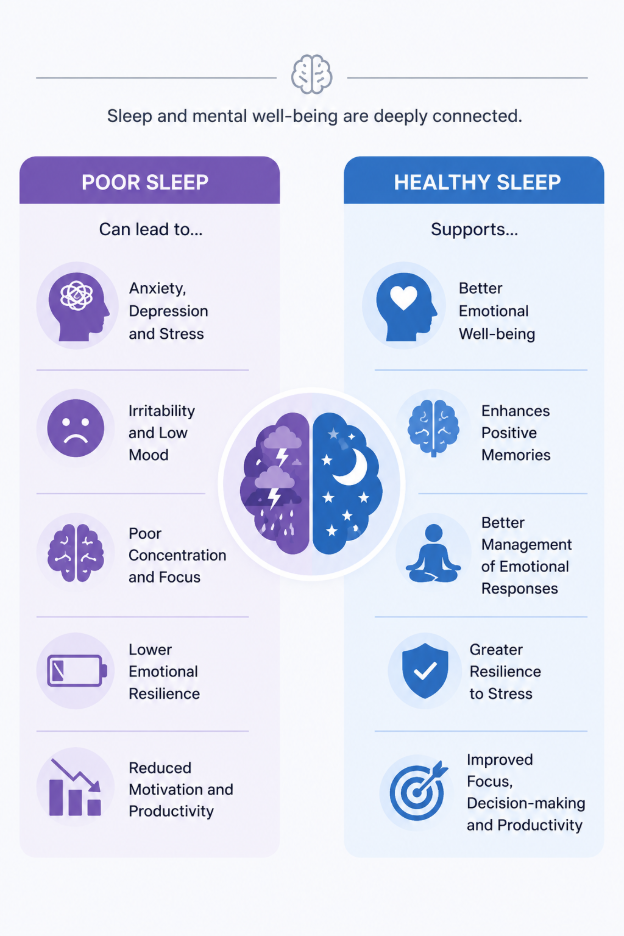
There is a relationship between sleep and psychological well-being. Insomnia may lead to problems such as anxiety, depression, and stress, while difficulties with psychological well-being also have an effect on one's sleep quality.
Sleep deprivation health effects lead to heightened emotional sensitivity and a lower capacity to cope with stress.
That is why poor sleep tends to be associated with depressed mood, irritability, difficulties with concentration, and emotional resilience.
In cases of healthy sleep, the brain enhances positive memories and manages emotional responses to stressful situations. When sleep is impaired, it makes it harder for the brain to cope with challenges that would normally seem minor.
Therefore, everyday problems can become triggers for heightened emotional reactions, and decision-making becomes harder. As a consequence, poor sleep may decrease motivation and productivity in the long term.
How to Break the Cycle of Poor Sleep
These are some research-based strategies that could really help:
- Maintain consistency in sleeping hours. Going to bed and getting up at the same time every day reinforces your body’s natural clock and eventually helps you fall asleep easily.
- Minimise blue light exposure. Turn off any screen one hour before going to bed so that the natural production of melatonin is not disturbed.
- Establish a routine for bedtime relaxation. Reading, some light exercise, and bathing are good indications for your nervous system to get ready for sleep.
- Make sure your bedroom is cold and dark. Your core body temperature should be lower for you to start sleeping.
- Take a low dose of melatonin. For people suffering from a disrupted circadian rhythm because of shift work, jet lag, and other reasons, melatonin could help with sleep onset.
To learn more about the research done on regular consumption of melatonin, here is an evidence-based answer.

Small Changes, Better Sleep
Insufficient sleep is possibly one of the most undervalued dangers to our health that we all face — and at the same time, one of the most solvable problems. The effects of sleep deprivation target each of the bodily functions, from neurological processes and immunity to the cardiovascular system and psychological state.
Correct sleep hygiene and, if necessary, minimal melatonin supplementation are two of the most scientifically grounded solutions. Some minor changes in your habits can have a significant effect — much more than you think!
So, if you want to take matters into your own hand and have quality sleep each night, then browse our collection of Melatonin line here and sleep without a worry.
FAQs
Q1: How many hours of sleep do adults need?
Most adults need 7–9 hours per night. Consistently getting fewer than 6 hours is associated with significant health risks.
Q2: What are the first signs of sleep deprivation?
Difficulty concentrating, irritability, slowed reaction times, and increased appetite are among the earliest signs — often appearing after just one night of poor sleep.
Q3: Can poor sleep cause weight gain?
Yes. Sleep deprivation raises ghrelin (hunger hormone) and lowers leptin (fullness hormone), increasing calorie intake. It also reduces the motivation to exercise.
Q4: How does lack of sleep affect the immune system?
After just a few nights of poor sleep, the body produces fewer infection-fighting antibodies and cytokines, making you more vulnerable to illness.
Q5: Does poor sleep affect mental health?
Yes. Chronic sleep deprivation is strongly linked to anxiety, depression, and mood instability. The relationship is bidirectional — poor mental health also disrupts sleep.
Q6: Can you catch up on lost sleep?
Short-term sleep debt can be partially recovered with extra sleep, but chronic sleep deprivation has lasting effects that cannot be fully reversed by a single long night.
Q7: What is the fastest way to improve sleep quality?
Consistent sleep/wake times, reducing blue light 1–2 hours before bed, keeping the bedroom cool and dark, and avoiding caffeine after 2 pm are the most evidence-backed first steps.
Q8: Can melatonin help with sleep deprivation?
Melatonin supports the natural sleep-wake cycle and can help reset disrupted sleep patterns — particularly useful for shift workers, travellers, or those with irregular schedules.