
What Is Melatonin And How Does It Work? A Complete Guide
 |
Key Takeaways
- Melatonin is a hormone, not a sedative.
- Does not influence the depth of sleep.
- Secreted by the pineal gland in response to darkness.
- Blue light reduces natural production.
- Supplements mimic natural production — they don’t force sleep.
You shut your laptop, turn down the lights, and in an hour, your eyes are drowsy, and your body is ready to relax. Nothing dramatic happened. No pill. No ritual. Only darkness and a hormone to do precisely what it’s intended to accomplish.
Melatonin is that hormone, but most people have a completely wrong idea about it.
Melatonin is not a sleep-inducing medicine, nor is it a sedative. It is a signal – one your brain gives each evening that night has come, and it is time to sleep. Once you get this signal right, then sleep comes easily. Disturb it, and even eight hours in bed leaves you feeling like you got four.
In this blog, you will learn what melatonin is, how your body produces it, what causes it to become imbalanced, and how to use sleep supplements to balance your melatonin levels and get a better night’s sleep.
Table of Contents
- What Is Melatonin?
- How Does Melatonin Work in the Body?
- What Is the Pineal Gland’s Role in Melatonin Production?
- What Triggers Melatonin Release?
- What Is the Difference Between Natural and Supplemental Melatonin?
- How Long Does It Take for Melatonin to Work?
- Melatonin vs Sleeping Pills: What’s the Difference?
- Slutsats
- FAQs
What Is Melatonin?
If you’ve ever felt that wave of drowsiness roll in around the same time each evening, melatonin is largely behind it.
But what is melatonin?
Melatonin is a hormone, or more precisely, a neurohormone, produced by the pineal gland, a small pea-sized gland located in the middle of the brain. It’s not to put you to sleep. Rather, it is a biological cue that signals your body that it is getting dark and it’s time to sleep. Instead of a sleeping pill, consider it more as an alarm clock that tells you it’s now time to unwind.
Melatonin is chemically related to serotonin, which is produced from the amino acid tryptophan, which is present in food such as turkey, eggs and nuts. The biochemical reaction in your body that converts tryptophan into serotonin and then into melatonin almost exclusively happens at night.
So, when people ask,” What is melatonin?”, the short answer is this: It is your body’s darkness hormone. It does not cause drowsiness. It gets you ready for it.
How Does Melatonin Work in the Body?
You might wonder, “How does melatonin work?”
Melatonin activates two types of receptors when it enters the bloodstream: MT1 and MT2, located in the suprachiasmatic nucleus (SCN) of the brain, the body’s main biological clock. Melatonin works through these receptors to help control your sleep-wake cycle, but not the quality or depth of sleep.
Let’s take a look at what happens on a typical day:
- Morning: Light enters the eyes and suppresses melatonin production. Cortisol rises. You feel alert.
- Afternoon: Melatonin stays low, and energy levels are highest.
- Evening (most adults: 9-10 pm): Light becomes less, and melatonin increases. The body’s internal temperature decreases. You become drowsy.
- 2 to 4 am: Melatonin is at its highest levels.
- Morning again: Signals from light tell the brain to cease producing. The cycle repeats.
This rhythm is part of what scientists call the circadian rhythm — your internal 24-hour biological clock. Melatonin is one of its most important chemical messengers. In the Journal of Pineal Research, the authors report that melatonin is a ‘time-giver’ that helps synchronise not only the master clock in the brain but also secondary clocks in the liver, pancreas, and other organs.
If this system functions well, sleep comes easily. Any disruption, whether due to shift work, jet lag or late-night screen time, affects your entire physiology.
What Is the Pineal Gland’s Role in Melatonin Production?
The pineal gland is very tiny — the size of a grain of rice — and has a surprisingly large effect on sleep. It is in the middle of the brain, outside the blood-brain barrier, and observes light signals sent across the retina.
When your eyes detect darkness, the signal travels along the retinohypothalamic tract to the SCN, which then stimulates the pineal gland to produce melatonin. This conversion process involves serotonin as its substrate, which is converted to melatonin by two key enzymes: arylalkylamine N-acetyltransferase (AANAT) and acetylserotonin O-methyltransferase (ASMT).
The pineal gland is really a light meter in the body. When the light is gone, it produces melatonin, not because you are tired.
An important aspect to keep in mind is that melatonin hormone levels naturally decrease with age. Research indicates that production begins to decline around age 40, and by the 70s, the pineal gland produces much less than during young adulthood. This is one reason many older adults struggle to fall asleep.
What Triggers Melatonin Release?
Darkness is the greatest stimulus for releasing melatonin. Specifically, it is the lack of light in the short-wavelength blue region of the spectrum.
The eyes have special cells known as intrinsically photosensitive retinal ganglion cells (ipRGCs) filled with a photopigment called melanopsin. These cells are especially sensitive to blue light (of wavelengths around 460-480 nanometres). When these cells receive blue light, they send an inhibitory signal to the pineal gland, telling it not to produce melatonin yet.
According to a study published in the Journal of Frontiers in Neurology, general exposure to short-wavelength blue light from electronic screens suppresses melatonin secretion and delays sleep onset.
In an experiment at Harvard University, blue light suppressed melatonin for approximately twice as long as green light of comparable brightness, shifting circadian rhythms by around three hours.
In actual practice, social media scrolling at 11 pm is not only stimulating the brain’s thinking, but it’s making your body think the sun didn’t set.
Other factors that suppress melatonin include:
- Bright overhead lighting in the evening
- Irregular sleep schedules
- Some medicines (such as some beta-blockers and NSAIDs)
- Alcohol consumption
- Travel to different time zones and shift work (alternate shifts)
Factors that support healthy melatonin production:
- Consistent sleep and wake times
- Dim, warm lighting in the evening
- Darkness in the bedroom during sleep
- Avoiding screens for at least 60–90 minutes before bed
What Is the Difference Between Natural vs Supplemental Melatonin?
Natural melatonin is the hormone your body makes itself, a tightly regulated hormone process that is associated with light and your body’s clock. Melatonin is also available as a supplemental ingredient, a chemical replica of the compound, taken orally to supplement or balance the production of natural melatonin.
The key difference isn't what they are; it’s when and why you use them.
Melatonin is naturally made by your body on its own schedule, usually in the hours leading up to your usual bedtime. However, you can use supplements when natural production is interrupted or insufficient, such as with jet lag, shift work, delayed sleep phase syndrome, or ageing.
Most importantly, supplemental melatonin won’t make you sleepy! It is not a replacement for your existing circadian system, but rather one that can work with it. Taking a low dose at the right time (usually about 30 to 60 minutes before bedtime) helps to synchronise the body clock. Too large a dose or at the wrong time can alter your rhythm in an undesirable way.
Vitasunn melatonin is available in various dosage strengths and forms (1mg to 10mg), allowing you to select the optimum option for your needs. For those who are just starting to use melatonin or experiencing mild sleep disruption, it may be better to start with a lower dose. For guidance on choosing the right amount, our melatonin dosage guide covers the evidence in detail.

How Long Does It Take for Melatonin to Work?
The peak blood level of standard melatonin supplements is usually reached in 30-60 minutes. That’s why timing matters as much as dosage; if you take the supplement just before bedtime, it may increase as your head hits the pillow!
Generally, sleep researchers recommend taking melatonin 30 to 60 minutes before the time you wish to sleep. Some guidelines recommend starting the protocol up to 2 hours before the target bedtime to shift the circadian clock more effectively for people suffering from jet lag and/or wanting to phase-shift their sleep schedule earlier.
Timed-release formats are different. They provide a slow release of melatonin over several hours, more closely resembling how melatonin is produced overnight. Vitasunn’s Timed Release 3mg is created with this in mind and is a convenient alternative for individuals who don’t struggle to fall asleep, but may get out of bed too early or have trouble staying asleep.
The key thing to remember is that melatonin is not a knock-out drug. You won’t experience a sudden change in how you feel. What you’ll notice is that, when it’s used properly, falling asleep is more natural; it’s not forced.
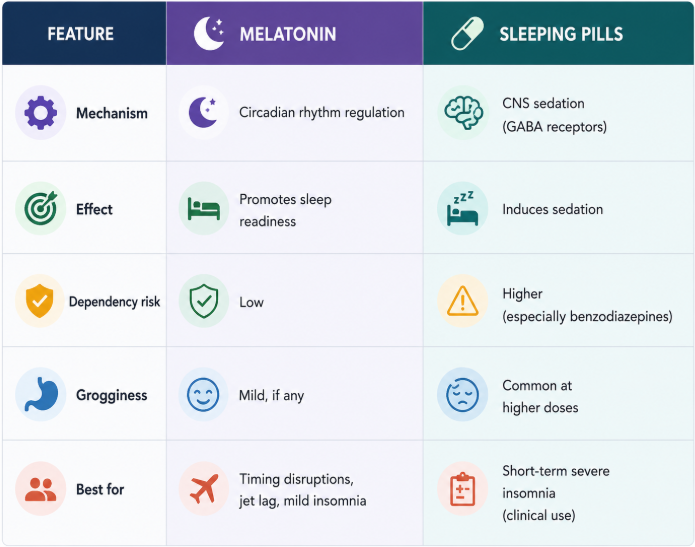
Melatonin vs Sleeping Pills: What’s the Difference?
One of the most common questions people have is which they should use: melatonin vs sleeping pills, and the distinction is significant.
The majority of over-the-counter sleep medications (such as the benzodiazepines and Z-drugs, like zolpidem) act on the GABA receptors in the brain, which have a sedative effect that essentially turns down the central nervous system activity. They can induce sleep fairly quickly. Still, they have drawbacks as well: dependency, grogginess the next day, rebound insomnia, and sleep that may be structurally different from natural sleep.
Melatonin is a completely different mechanism. It acts on the body’s own circadian receptor system (MT1 and MT2 receptors) and facilitates the action of your body’s clock, not disrupts it. It doesn’t sedate; it synchronises.
Here’s a quick comparison:
If you’re currently taking prescription sleep medication and considering melatonin, it’s worth speaking to a healthcare professional first. For more on safety considerations, our article on whether it’s safe to take melatonin every night clearly covers the research.
 |
Supporting Better Sleep
One of your body’s most basic biological signals is the melatonin hormone, which signals to your internal clock that it’s time to fall asleep. It does not cause sleepiness, but only sets up the circumstances for it.
To make the best use of melatonin, it is important to understand how it functions—timing and dosage matter. Light exposure in the hours before bed also matters. And increasingly, research suggests that protecting your natural melatonin production — by reducing screen use in the evenings and keeping a consistent sleep schedule — is just as important as any supplement.
When supplementation makes sense, Vitasunn’s range of melatonin products (1mg through to 10mg, in both standard and timed-release formats) allows you to select your preferred format.
Check out the full range, and choose the one that suits you.
Frequently Asked Questions
Q1: What exactly is melatonin?
A hormone secreted by the pineal gland, signalling darkness, and making one ready for sleep — not a sedative.
Q2: Is melatonin a sleeping pill?
No, melatonin does not work like sleeping pills, but it helps synchronise the body’s natural cycle to induce a more natural sleep.
Q3: How does melatonin make you feel?
Moderate sleepiness and decreased alertness — not full sleepiness. Ideal time of use is 30–60 min before sleep.
Q4: What is the difference between melatonin and sleeping tablets?
Sleeping medications act on the GABA receptors; melatonin acts on the circadian rhythm receptors.
Q5: Does your body stop producing melatonin if you take supplements?
Occasional supplementation doesn’t significantly suppress natural production; long-term high-dose use warrants caution.
Q6: At what age does melatonin production decline?
Natural production begins to decline around age 40, contributing to age-related sleep difficulties.
Q7: Can you take melatonin during the day?
Not recommended — it can shift circadian rhythm in the wrong direction and cause daytime grogginess.
Q8: Does light really suppress melatonin?
Yes. Blue light from screens can suppress melatonin release by up to 50%.
Bidrag Dec-2022 av Alex Harpy från Sovande test
Melatonin är ett hormon som produceras naturligt i kroppen och som är inblandat i sömnregleringen. Det kallas ofta för "sömnhormonet" eftersom dess nivåer ökar i kroppen på natten och signalerar till kroppen att det är dags att sova.
Melatonin finns receptfritt som kosttillskott i USA, men det är viktigt att tala med en läkare innan du använder det. Rätt dosering av melatonin kan variera beroende på ålder, vikt och andra faktorer, och en läkare kan hjälpa till att bestämma rätt mängd för en individ. Om du bor i Europa kan Vitasunn skicka och leverera melatonin inom EU där det är svårt att hitta. Melatonin förskrivs vanligen vid sömnstörningar där både sömnens kvantitet och kvalitet påverkas.
Vanliga sömnstörningar
Sömnlöshet: Sömnlöshet är den vanligaste sömnstörningen och kännetecknas av svårigheter att somna eller att somna om, eller att man vaknar och känner sig outvilad. Sömnlöshet kan orsakas av en rad olika faktorer, bland annat stress, ångest, depression och vissa mediciner.
Sömnapné: Sömnapné är ett tillstånd där en persons andning upprepade gånger avbryts under sömnen, vilket gör att personen vaknar ofta under natten. Detta kan leda till överdriven sömnighet på dagtid och andra hälsoproblem.
Narkolepsi: Narkolepsi är en neurologisk störning som påverkar kontrollen av sömn och vakenhet. Personer med narkolepsi upplever överdriven sömnighet under dagtid och kan ha plötsliga, oemotståndliga sömnepisoder under dagen.
Behandlingen av sömnstörningar varierar beroende på störningens typ och svårighetsgrad. Den kan omfatta livsstilsförändringar, till exempel förbättrad sömnhygien, eller användning av läkemedel eller andra terapier. Det är viktigt att tala med en vårdgivare för att få en korrekt diagnos och lämplig behandling.
Kosttillskott med melatonin
Melatonintillskott finns i en mängd olika former, inklusive tabletter, kapslar och vätskor. Några vanliga typer av melatonintillskott inkluderar:
Melatonin med omedelbar frisättning: Denna typ av melatonintillskott är utformat för att snabbt absorberas i kroppen, vilket möjliggör snabba effekter. Det används ofta för behandling av jetlag eller för att hjälpa till att somna.
Melatonin med förlängd frisättning: Denna typ av melatonintillskott är utformat för att frisättas gradvis under en längre tidsperiod, vilket ger mer långvariga effekter. Det används ofta för behandling av sömnlöshet och andra kroniska sömnstörningar.
Melatonin med tillsatta ingredienser: Vissa melatonintillskott innehåller ytterligare ingredienser, såsom örter eller andra föreningar, som kan hjälpa till med sömn eller avkoppling. Till exempel kan vissa melatonintillskott innehålla valerianarot eller GABA (gamma-aminosmörsyra) för att förbättra deras effekter.
Det är viktigt att notera att effektiviteten och säkerheten hos melatonintillskott kan variera beroende på produktens typ och kvalitet. Det är alltid bäst att prata med en vårdgivare innan du använder något tillskott, inklusive melatonin.
Kan melatonintillskott hjälpa till med sömnapné?
Det finns bevis som tyder på att melatonin kan vara effektivt vid behandling av sömnapné. I en studie utförd av University of California, San Diegofann forskarna att melatonin förbättrade sömneffektiviteten, minskade antalet uppvaknanden och ökade den tid som tillbringades i djupsömn hos patienter med sömnapné.
En annan studie publicerad i tidskriften Journal of Clinical Medicine stöder bevis för den måttliga effekten av melatonin och en melatoninreceptoragonist (ramelteon) för att öka den totala sömntiden och minska sömnlatensen. Forskarna fann också att melatonin hade en positiv effekt på nervsystemet, som är involverat i regleringen av andningen under sömnen.
Förutom de potentiella fördelarna med sömnapné har melatonin också visat sig ha andra positiva effekter på sömnen. Det kan bidra till att minska den tid det tar att somna, förbättra sömnkvaliteten och minska symtomen på jetlag.
Andra behandlingar för sömnapné
Även om melatonin kan vara effektivt vid behandling av sömnapné är det inte en universallösning. I vissa fall krävs andra behandlingar, såsom kontinuerligt positivt luftvägstryck (CPAP)som levererar luft genom en mask för att hålla luftvägarna öppna under sömnen. Andra behandlingar kan vara viktnedgång, livsstilsförändringar och kirurgi för att avlägsna överflödig vävnad från luftvägarna.
Viktnedgång kan också vara en effektiv behandling av sömnapné, eftersom övervikt kan bidra till att luftvägarna blockeras. Att gå ner i vikt kan bidra till att minska svårighetsgraden av sömnapné och förbättra sömnkvaliteten.
Livsstilsförändringar, som att undvika alkohol och sova på sidan, kan också bidra till att lindra symtomen på sömnapné. Att undvika alkohol kan vara särskilt fördelaktigt eftersom det kan få musklerna i halsen att slappna av.
I vissa fall kan kirurgi vara nödvändigt för att behandla sömnapné. Ingrepp som uvulopalatofaryngoplastik (UPPP) och laserassisterad uvulopalatoplastik (LAUP) kan hjälpa till att avlägsna överflödig vävnad från luftvägarna och förbättra andningen under sömnen.
Det är viktigt att träffa en läkare för att få en korrekt diagnos och behandlingsplan för sömnapné. Obehandlad sömnapné kan leda till allvarliga hälsoproblem och försämrad livskvalitet. Att prioritera god sömn är viktigt för den allmänna hälsan och välbefinnandet.